
Types of Sake and Storage
●Types of Sake
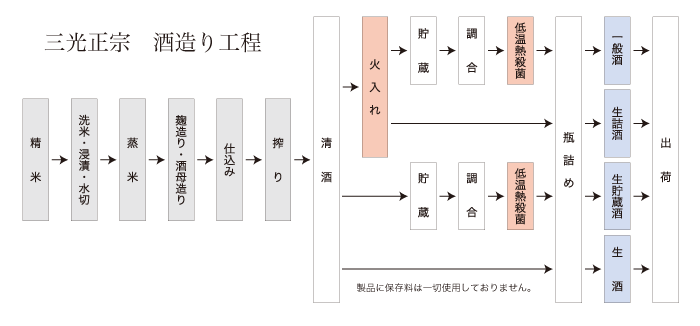
- Namazake: unpasteurized
Sake called "nama" that is not pasteurized tastes best served chilled. It has the freshest character, and is very delicious, but because the sake itself is so pure, it can spoil quickly, and the shelf life is short. If stored in a refrigerator, the shelf life is about 3 months from the production date.
Our brewery offers items such as Nigori Genshu, Namazake, and Hinokuchi. - Nama Chozoshu: pasteurized once
Sake that is not pasteurized during storage, but is pasteurized when bottled, is called Nama Chozoshu. Because it is not pasteurized before storage, it has a fresh character. After a storage period, it is pasteurized, so it has a slight aged feel, making it a sake with both freshness and depth of flavor. The shelf life is about 1 year from the production date, but please store it in the refrigerator as much as possible and drink it soon.
Our brewery offers items such as Sanko Nama Chozoshu. - Regular sake: pasteurized twice
It is pasteurized twice, once before storage and once when bottled. It generally retains its bottled quality for about one year from the production date. However, this does not mean that sake purchased more than a year ago cannot be enjoyed. Why not try it as an aged sake? Unopened sake does not have a strict best-before date for flavor.
Our brewery offers items such as Sanko Masamune Daiginjo, Sanko Masamune Ginjo, Sanko Masamune Junmai Daiginjo, Sanko Masamune Junmai Ginjo, and Sanko Masamune Junmai Sake.
This "pasteurization" refers to the process of low-temperature heat sterilization of sake at around 65°C.
The biggest problem in sake deterioration is spoilage. Spoilage is caused by microbial contamination, and it is known that many microorganisms can be sterilized by heat.
By applying heat, microorganisms remaining in the sake are eliminated, and enzyme activity is stopped to stabilize the quality.
Today, quality is preserved by combining low-temperature heat sterilization with precision filtration technology
●No preservatives are added to sake at all.
The aroma and color of sake begin to change as soon as it is pressed.
To enjoy sake at its best, these three points are important: "store it in a cool place," "keep it away from ultraviolet light," and "do not expose it to air."
Please note that if it is left in a place with high heat or direct light, the flavor will deteriorate.
- Do not store it in places with large temperature swings.
Sake does not do well in places with large temperature differences. Exposure to high temperatures accelerates deterioration.
It is best to store it in a low-temperature place with as little temperature change as possible, such as underfloor storage.
This allows the sake to age slowly and become smoother. - Do not expose it to ultraviolet light.
Light from the sun or fluorescent lamps contains ultraviolet rays. If sake is exposed to ultraviolet light, it can become strongly colored and the quality can deteriorate, so
storing it in the shipping box or wrapping it in newspaper helps keep it in good condition. - Unopened bottles are fine, but after opening, seal them tightly so they are not exposed to air.
Also store them in a stable place without shaking. Unstable places with strong vibration will accelerate oxidation and lead to deterioration.